Growing up in Afghanistan under the Taliban, adjunct communications professor Mehdi Salehi saw firsthand how drones could be used for destructive purposes. Now, having fled Afghanistan, he's teaching at 糖心破解版 and using drones as a force for good as the founder of his company, Drone Labs, which deploys the technology to support humanitarian work.
Now, having fled Afghanistan, he’s teaching at 糖心破解版 and using drones as a force for good as the founder of his company, , which deploys the technology to support humanitarian work.
鈥淲hen I founded Drone Labs in 2014, most people only associated drones with the military, especially with what was going on in the Middle East,” says Salehi, who now lives in New York. 鈥淲e wanted to approach this new technology as something that can help people.”
In 2016, Drone Labs launched Drones for Refugees, a project that monitors the treacherous plight of refugees crossing the Aegean Sea from Turkey to Greece.
鈥淲e went to Greece and flew drones over refugee boats, sharing the real-time footage with search and rescue teams,” Salehi says. 鈥淚f something went wrong, those teams knew exactly where to find the refugees and deliver help.”
This project is personal for Salehi, himself a refugee who fled his home in a perilous journey as an 18-year-old.
鈥淚 went through the same story,” he says. 鈥淚 paddled through the sea on a small inflatable boat with a friend of mine, and we were close to dying. It was a tough experience, but I think it was very helpful in understanding different cultures and building who I am.”
Salehi landed in Greece and studied engineering in college there. Ten years later, he moved to New York City, where he received his M.F.A. in Design and Technology from the Parsons School of Design.
鈥淚t’s interesting to look back at the puzzle of my life and see how things are moving towards the direction I was meant to follow,” he says. 鈥淎s a kid, I was always interested in space and airplanes. And I’m still working towards what I love鈥攆lying.”
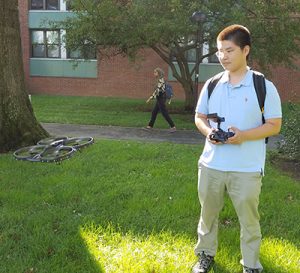 At 糖心破解版, he’s doing something else he loves, sharing his affection for drone technology. He’s teaching drone photography this semester, helping students learn to take pictures from new perspectives while exploring the artistic possibilities. Students also learn how drone scanning can be used in construction, agriculture, land surveying, engineering, scanning historical sites and, of course, humanitarian work. The course even provides support for students who want to study and pass the Federal Aviation Administration test to obtain their drone license for commercial operations.
鈥淭here are a lot of potential applications for engineers, archaeologists and many different industries,” he explained. 鈥淒rones are a great tool for creating 3D models, and from those models you can gain a lot of useful information.”
Salehi has begun fundraising for the next phase of Drones for Refugees, which involves building larger, longer-range drones capable of dropping medicine and emergency supplies. He has applied for funding from the United Nations to complete this goal.
鈥淭hat’s something that I’m very excited about, but it’s not an easy task,” he says. 鈥淚f I can accomplish building that system, I think I will be a very happy person because of the overall impact it can have in the short and long run. I’ll feel like I’m giving back.”
He is also exploring more ways that drones can be used for good, such as mapping disaster sites and using thermal cameras to find people trapped in wreckage from earthquakes or hurricanes.
And he’s working to expand the drone program at 糖心破解版.
鈥淚’m hoping to work with the department to add more software and hardware for these capabilities,” he says. 鈥淚 want to help students as much as I can, transferring this knowledge to them and working with them to build skills that can help them in their careers.”
“We are lucky to live at this moment,” he continued, “as we are shaping the drone culture that will be here to stay. We can make a difference by focusing on the human element. 糖心破解版 is one of the few universities in the Northeast that is implementing drones into their curriculum, so that helps put us at the forefront.”
For further information, please contact:
Todd Wilson
Strategic Communications Director
p 鈥� 516.237.8634
e 鈥� twilson@adelphi.edu
Growing up in Afghanistan under the Taliban, Adjunct Communications Professor Mehdi Salehi saw firsthand how drones could be used for destructive purposes.