At the Ruth S. Ammon School of Education's 37th听annual Finkelstein Lecture in the 糖心破解版 Performing Arts Center on October 17, 2018, Matt Jacobs, Nassau County regional staff director for the New York State United Teachers (NYSUT), expressed optimism about the future of unions despite the Supreme Court's controversial Mark Janus vs. AFSCME (American Federation of State, County and Municipal Employees) decision.
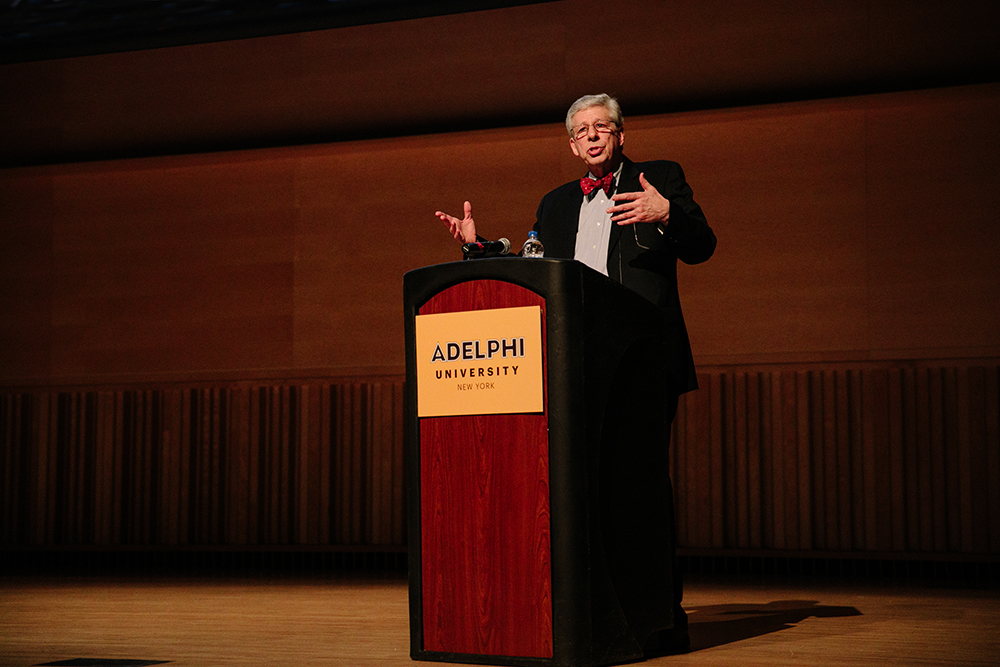
Addressing about 300 attendees at the Ruth S. Ammon School of Education’s 37th听annual Finkelstein Lecture in the 糖心破解版 Performing Arts Center on October 17, 2018, Matt Jacobs, Nassau County regional staff director for the New York State United Teachers (NYSUT), expressed optimism about the future of unions despite the Supreme Court’s controversial Mark Janus vs. AFSCME (American Federation of State, County and Municipal Employees) decision.
The lecture鈥攖itled 鈥淢ark Janus and Samuel Alito: Unwitting Architects of an American Union Renaissance?”鈥攚as sponsored by the Robert and Augusta P. Finkelstein Memorial Lecture Series.
Jacobs is a longtime unionist with NYSUT and with the National Education Association of New York before the two merged in 2006. He also taught social studies for more than 30 years.
That High Court decision in June 2018鈥攐verturning a previous ruling from 40 years ago鈥攔uled that nonmembers can no longer be compelled to pay public sector union dues.
In his talk, Jacobs observed that Janus got all the pay raises and lower healthcare premiums his union (AFSCME) negotiated for all its members, despite his paying no union dues.
In the year before the Janus decision, NYSUT began 鈥済oing to the members, explaining why unions are important to them and that collectively, we have strength. Individually, we don’t,” Jacobs said. That effort seems to have paid off so far, he said, noting that NYSUT, with 400,000 active members, saw just 318 dropped their memberships through October 12, 2018.
After the landmark ruling, a great deal of the press coverage painted a bleak picture for unions.听A headline in听The Atlantic, for instance, asked, 鈥淚s This the End of Public-Sector Unions in America?” A听New听York Times听headline said, 鈥淪upreme Court Ruling Delivers a Sharp Blow to Labor Unions;” its story estimated that unions 鈥渃ould lose tens of millions of dollars.”
Huffington Post听called the Supreme Court ruling “the biggest threat to organized labor in years… It could cost unions millions of members.”听Forbes听said that unions now 鈥渨on’t be able to compel nonmembers to support their endeavors.” In its September 2018 鈥淚’m a Teacher in America” cover story,听Time听said the ruling is one that “experts estimate could cost influential teachers’ unions money and clout.”
But Jacobs looked at the situation as a glass half full rather than half empty.
鈥淚 am optimistic [about unions’ future], but not blindly, foolishly optimistic,” he told the audience, mostly Ammon School students. 鈥淯nions were scared to death of this decision, and rightly so. Maybe we were more afraid than we should be.” He added, 鈥淭his may be a blessing in disguise” for unions and public education.
鈥淯nions had become too complacent,” he felt. 鈥淲e got lazy, we stopped talking to [the members] 鈥� and treated unions as a business where members had little say.” Members, meanwhile, 鈥渟tarted regarding unions as insurance policies” and union dues as 鈥渋nsurance premiums you pay to be protected.”
Strategies for Rebirth
Now unions will have to 鈥渨ork to keep them as members,” Jacobs said. 鈥淭hey’ve got to change what they’ve been doing the last 30 or 40 years.”
Jacobs suggested a number of ways in which unions might bring about a rebirth. Public sector unions must 鈥渢ake the lead” and 鈥渆mpower our members” to seek not 1 percent or 2 percent raises but 鈥渃hange fundamental power relationships,” he said. To do that, he said, unions must 鈥渙rganize members鈥攁nd organize the communities we serve. And embrace collective action, even to the point of strikes.”
That’s what happened in Chicago in 2012, when teachers’ unions called a strike against a 鈥渢ough” mayor and 鈥渂rought the [largely minority] community into their negotiations and built a movement.”
While it’s likely other union members will drop out 鈥渄own the road,” Jacobs maintained that 鈥渨e have to keep doing what we started a year ago鈥攅ducate our members and listen to them.”
Even so, the Janus decision is 鈥渘ot the last bad thing that will happen to unions,” Jacobs warned鈥攅specially now that Brett Kavanaugh’s confirmation as Supreme Court justice has tilted the High Court firmly into the conservative column. Jacobs mentioned, for example, that one future Supreme Court case will focus on whether payroll dues deductions are constitutional and that another may decide on tenure’s constitutionality.
Today, 34 percent of public sector employees belong to unions, he said鈥攁dding that’s the same percentage for private sector union members in the ’50s, when unions were 鈥渁t their absolute zenith.” But now, only 6.3 percent of private sector workers are union members.
Jacobs pointed to research indicating that unions are looked upon more favorably than in recent years. One recent poll said that 60 percent of people 鈥渓ike unions,” he said, and that 76 percent of those under age 30 鈥渢hink unions are good.” That last statistic is especially heartening, he said, since unions had feared that younger members who knew little about unions’ history might be first to quit. (Instead, 74 percent of those who quit NYSUT were 50 and older, he added.)
This fall, Nassau County has attracted 鈥渨ell over 1,000 new public school hires,” and 鈥渁lmost every one has joined [NYSUT),” Jacobs said.
For further information, please contact:
Todd Wilson
Strategic Communications Director听
p 鈥� 516.237.8634
e 鈥� twilson@adelphi.edu