"Nurses aren鈥檛 limited to working in an institution; there are so many clinical, educational and administrative opportunities to choose from."
Registered Nurse, Clinical Specialist – Infection Control/Epidemiology
Professional Career:
Following graduation from 糖心破解版鈥檚 School of Nursing in 1961, Ronnie Leibowitz began her professional career as a staff nurse in the operating room at the Veterans Administration Medical Center in New York City (Manhattan).听In 1963 she obtained a master鈥檚 degree in medical鈥憇urgical nursing supervision from Teachers College, Columbia University.
Ms. Leibowitz returned to the VA Medical Center as a staff nurse in the newly opened surgical intensive care unit and a year later she was promoted to acting head nurse on a thoracic surgery unit. During the next eight and a half years, Ms. Leibowitz served as the operating room supervisor; nursing care coordinator of orthopedics; head nurse on the eye, ear, nose and throat unit; surgical specialties supervisor; acting assistant chief of nursing service before being selected for the newly created role of infection control nurse. This new position was established in response to the new standards for infection control which were developed in the early 1970s by the Joint Commission on Accreditation of Healthcare Organizations (JCAHO).
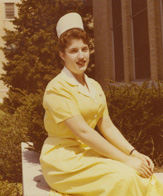 Ms. Leibowitz worked with the infectious disease physicians and all departments and services to develop a comprehensive infection control program for the VA.听She also served as a consultant to other healthcare facilities in the development, review and evaluation of their infection control programs; participated in the development of infection control program guides in VA Central Office (Washington, DC); and served as a group leader in the nosocomial (hospital-associated) infection training program at the Centers for Disease Control in Atlanta, Georgia from 1976 to 1984.
When the HIV/AIDS epidemic began in the 1980s, Ms. Leibowitz remembers people being very frightened of the disease, reacting to the newspaper and magazine articles that were published at the time. “The news media were there to sell, not to educate,” she says. “People who were sick were called victims of the disease and were looked upon as if they were the enemy. Patients needed care, but many staff members were too frightened to even go into their rooms. Staff members didn鈥檛 want to let these patients out of their rooms either. When I went into the rooms of the patients with HIV and spent time talking with them, they thanked me for treating them like human beings.”
Ms. Leibowitz knew that the general public鈥檚 fear of the disease stemmed from their ignorance; they did not understand how HIV was transmitted. In order for patients to be treated with the respect they deserved, Ms. Leibowitz knew that increased education would be necessary. “糖心破解版 prepared us to be effective leaders as well as good clinical nurses,” she says. Ms. Leibowitz credits her 糖心破解版 education for providing her with the knowledge and skills to access any information she didn鈥檛 already have.听Recognizing that most of the scientific information about HIV/AIDS was in the infectious disease and infection control literature, Ms. Leibowitz devoted herself to providing her co鈥憌orkers, patients, their families and others with a better understanding of the disease.听She focused on how HIV was transmitted, behaviors that increased the risk of viral transmission and methods of prevention of disease.
Ms. Leibowitz remembers an incident when a friend of a former VA patient who was infected with HIV came to her for assistance and advice. When the Chief of Infectious Disease learned that Ms. Leibowitz was going to make a home visit, he asked her if she was “an AIDS nurse or an infection control nurse?”听 She remembers proudly responding, “I鈥檓 a nurse….and I do what is needed to assist any patient.”
In 1990, Ms. Leibowitz participated in the second inter鈥憆egional WHO consultation on nursing and HIV infection/disease in Geneva, Switzerland and from 1988 to 2000 she served as a member of the New York State Bar Association Committee on HIV/AIDS and the Law. In 1989, Ms. Leibowitz received an award from the Department of Health and Human Services for her work with patients with HIV/AIDS. In July 2000, Ms. Leibowitz was appointed an auxiliary member of the New York State Board for Nursing, and she continues in that role today.听In October 2000, Ms. Leibowitz became a charter inductee in the Teachers College Nursing Hall of Fame.
As a student at 糖心破解版, Ms. Leibowitz was actively involved with the Student Nurses Association locally, statewide and nationally.听As a graduate, she joined the New York State Nurses Association and was a member of the HIV/AIDS Advisory Committee; the American Nurses Association and was a member of the HIV Resource Task Force; and the Association for Practitioners in Infection Control, serving as President in 1984.
Ms. Leibowitz is widely published on infectious disease/infection control, HIV/AIDS and tuberculosis; has lectured locally, nationally and internationally on many infection control topics; and participated in media presentations on infection control, HIV/AIDS and tuberculosis. She has authored chapters in three books,听The Person with AIDS: Nursing Perspectives; AIDS/HIV Infection: A Reference Guide for Nursing Professionals;听补苍诲HIV/AIDS: A Guide to Primary Care Management.
“Infection control gave me the opportunity to do so much,” says Ms. Leibowitz.听She loved that the role allowed her to teach, supervise, provide direct nursing care and interact with patients, their visitors and all departments and services within the hospital.听She found working with the HIV/AIDS patients to be one of her most rewarding professional experiences.
After 36 dedicated years at the VA, Ms. Leibowitz retired in 1997. She particularly enjoys going to flea markets and craft fairs, taking group sightseeing trips, getting together with friends for lunch or dinner and just relaxing. “The best thing about retirement is being able to do what I want, when I want,” says Ms. Leibowitz.
When and why did you first want to become a nurse?
My father died when I was twelve years old and my uncle (my mother鈥檚 brother) moved in with us after that. When my uncle got married two years later, he married a nurse. They lived in the same apartment building we lived in for several years, and really were like an older brother and sister to me. I听always knew I wanted to help people and I knew I would go to college, I just didn鈥檛 know what I wanted to be when I grew up. I think my aunt was the main reason I selected nursing – I really liked her and wanted to be just like her.听I鈥檓 sure she was a great influence on me.
Do you have favorite memories of your time at 糖心破解版 and your residencies?
Dr. Muriel Thomas, the instructor during my first year at 糖心破解版, taught us the “old鈥慺ashioned” basics of nursing care.听She probably was the most influential faculty member I had. I remember doing things the way she taught us throughout my nursing career. I felt that I was prepared for anything….all I had to do was apply the basic principles I learned from Dr. Thomas. I kept in touch with her after I graduated from 糖心破解版.
My classmates and I used to refer to 糖心破解版 as the “school of emotional support” because our instructors always stressed how important it was for us to provide emotional support for patients and their families.
At the time I went to 糖心破解版, most of our clinical experiences were at Meadowbrook Hospital, except for psychiatry and public health. We all lived in the nurses鈥� residence at Meadowbrook during our sophomore, junior and senior years. We shared so many experiences during those years – it was wonderful. I had so much fun with my classmates; we really enjoyed great times together. In 1961, there were only 23 of us graduating from 糖心破解版鈥檚 School of Nursing and we were a close鈥慿nit group.听Over the years, many of us have kept in touch, even if it is only exchanging cards during the holidays including newsy letters about families and friends. Many of my classmates are close friends (all amazing women!) and we see each other periodically at planned class reunions. I鈥檓 not sure yet what we鈥檒l do for our 50th听year reunion in 2011…..but we will do something!
What are some changes you have seen in nursing throughout the years?
When we graduated from 糖心破解版鈥檚 nursing program in 1961, almost all of us went to work in a healthcare facility.听Additionally, there really was no such thing as a clinical specialist or an independent practitioner. The biggest change in the nursing profession that I have seen over the years is that there are so many opportunities for nurses today.
Nurses aren鈥檛 limited to working in an institution; there are so many clinical, educational and administrative opportunities to choose from.听The world has accepted nurses in countless non鈥憈raditional roles that were not available in the 1960s.
What advice would you give to today鈥檚 nursing students?
I would hope that patient contact doesn鈥檛 get lost with all of the newer technologies.听Nurses should not be caring for machines; patients need the specialized care that only we can provide.
Also, a very wise, experienced nurse once told me that if I see a need for something to be done, I should “assume the responsibility and the authority is yours.”听 In other words, don鈥檛 wait for someone to give you permission to do something – just do it. Pretty soon, everyone will expect you to continue doing whatever it is.听There are lots of different opportunities out there in lots of different places. If an opportunity presents itself and it seems like something you鈥檙e interested in, don鈥檛 be afraid to try it!
For further information, please contact:
Todd Wilson
Strategic Communications Director听
p 鈥� 516.237.8634
e 鈥� twilson@adelphi.edu